Thursday, November 30, 2006

Done with the Compass! Done with the Chart!


Well, actually, done with grading--but it feels so, so good.

I was tough this quarter, tougher than I've been in many a year. I kept myself honest as I graded. When I hit a paper that was just OK--not bad, not horrible, not ghastly, but not inventive, clearly written, or particularly insightful, either--I didn't shrug it off with a B- to keep the student from complaining or, worse, from hating poetry.

I gave it a C.

Then I did something worse.

On the final, I gave a series of objective questions. You know, things like a list of 10 words we looked up in class because their meanings turned out to be crucial to the poems we were reading. I gave the word, I gave the line or phrase, and I asked the students to tell me what the relevant meaning was.

Oops.

I also asked them to describe a couple of literary schools or movements--just with a sentence or two--and say which poets we studied belonged to them.

Oops again. Did you know that Langston Hughes was a poet of the New York School? His work there evidently paved the way for Wallace Stevens, author of "The Red Wheelbarrow" and other works of the British Romantic movement.

What we say, what they hear. What they read, what they remember. I had students scoring single digits on a 50 point final exam.

Now, I don't know about your department, but mine has been under pressure recently to foster an "atmosphere of rigor" in classes. I'd like to say that I gave those grades and asked those questions to put a whiff of rigor--smells like teen dispiritedness--into my students' nostrils. But mostly I did it to live with myself for the next 25 years, teaching this course, facing these students. I need to be a hard-ass for a while.

Maybe my students feel betrayed this week, as though Captain Stubing suddently turned into Captain Ahab when exam week rolled around. Next quarter, I'm going to tell them on day one that I will, if need be, give a third of them A's, a third of them B's, and a third of them C's. But as God is my witness, I told the folks that didn't come to class, or who came and sat there without taking notes, or taking part, or taking the time to read the text, that the final was going to get them, and it did, just like the Kraken.

As for the 9 students who got an A from me this time?

Congratulations, kids. You earned it. And I can honestly say--not that I would ever, ever lie about such things, natch--that I hope I'll see you in a class again.

Tuesday, November 07, 2006

Ammons on Andrew Sullivan's Blog

Of all poets, A. R. Ammons shows up on Andrew Sullivan's blog today: "Corson's Inlet," as illustration, I suppose, of the "conservatism of doubt" that Sullivan champions. I'll take Ammons on Sullivan over Bruce Andrews on O'Reilly any day of the week.

Check it out here.

Also, swing by the Chicago Review's on-line anthology of work from their sixty years of publication. I'm tickled to see how often Ronald Johnson shows up as a contributor. Now how do I get Sullivan to read Ron? Hmmmm...

Saturday, November 04, 2006

Hot Fun in the Summer Time

Welcome to November, everyone! And if it's November, that means it's time for the NEH to announce their upcoming round of Summer Seminars and Institutes. Some of these are for college faculty; you can find that list here. For our purposes, the crucial list is here: the seminars and institutes for K-12 Teachers. Each runs from two to six weeks; for each you get paid a stipend of $1,800 (2 weeks), $2,400 (3 weeks), $3,000 (4 weeks), $3,600 (5 weeks), or $4,200 (6 weeks) to cover transportation, living expenses, and so on.

This year, the NEH will sponsor two, yes two seminars for teachers of poetry! The first will be at Harvard, taught by Helen Vendler:

Poetry as a Form of Life, Life as a Form of Poetry
July 2-July 20, 2007 (3 weeks)
Helen Vendler
Harvard University
Information: William Holinger
Harvard Summer School
51 Brattle Street
Cambridge, MA 02138
617-998-8515
william_holinger@harvard.edu

The second (drum roll please) will be right here at DePaul, taught once again by yours truly:

Say Something Wonderful: Teaching the Pleasures of Poetry
June 25-July 27, 2007 (5 weeks)
Eric Murphy Selinger
Department of English
DePaul University
802 West Belden Ave.
Chicago, IL 60614
773/325-4475
aperson@depaul.edu

And yes, that's a real email address, not just a placeholder!

Keep in mind that you can only apply to one (1) of these two seminars; the NEH has a firm rule about that, and I have seen good teachers barred from participation for a year because they broke it. So write to both addresses for information, decide which city, which length of program, and which content better suits you, and then get busy with your application!

Saturday, October 14, 2006

Mahmoud Darwish

I've noticed poems by Mahmoud Darwish creeping into American anthologies recently. The latest edition of Poetry: an Introduction, for example, boasts one, although not one of his best. (I find all such textbooks intensely depressing these days, about which I must blog when I get the time.) Unless you read the Israeli newspaper Ha'aretz, however, you might have missed this rather useful piece about the poet, one which might let you teach him alongside Yeats, rather than in the contexts the anthologies tend to suggest. Here it is, then: read, learn, and enjoy!

Palestine as poetry

By Sami Shalom Chetrit

"Tziur kir" ("Mural") by Mahmoud Darwish, translated into Hebrew by Muhammad Hamza Ghanaim, Andalus Publishing, 102 pages, NIS 68

Unlike William Butler Yeats' pronouncement of the death of the romantic Ireland, the romantic Palestine has not died; it is alive and throbbing between the lines of Mahmoud Darwish's poems. And, in fact, for Darwish, as for Yeats, it is becoming more and more romantic as its dream grows more distant. It is becoming a poem, like a distant, lost love.

Darwish loves Yeats and his poetry is very reminiscent of Yeats' work - on the one hand, in the dramatic rhythms, on the other, in the position of the speaker as a simple man, and in its deliberate and striking language. Above all, it is similar to Yeats in the burning need to document and store the collective memory, not in large epics, but rather in simple lines about the experience of the transient individual, who is aware of his weakness and smallness, but also protests strongly and with the last ounce of his strength against destruction itself, and challenges it, as in this breathtaking long poem, "Tziur kir" ("Mural").

Edward Said once said of Darwish's poetry that it is "an epic effort to transform the lyrics of loss into the indefinitely postponed drama of return." In this respect, too, Darwish resembles a Jewish Diaspora poet who, through his words, transforms the hopeless expectation for redemption. He exchanges the poetry of mourning for redemption. Again and again he reinvents a cut-down realm of longings, as in Darwish's words on exile: "Exile is not a geographical situation, I take it with me everywhere, just as I take my homeland, a land of words." It is no wonder then that 25,000 Palestinians and Lebanese gathered in a stadium in Beirut to seek shelter, if only for a brief while, in the shade of the homeland of words that Darwish has created for them.

Unlike the order in which they were originally published in Arabic, "Mural" appeared here in Hebrew after "State of Siege" (also published by Andalus and in Muhammad Hamza Ghanaim's wonderful Hebrew translation, which perhaps can be said to be Arabic in spirit). Therefore my first impulse after reading "Mural" was to go back to "State of Siege" and read it again, this time in the proper order, which is a crucial matter in Darwish's poetry, which Ferial J. Ghazoul, a scholar of Arabic literature, has called "the lyrical diaries of the Palestinian saga." But I came to the rereading of "State of Siege" exhausted psychologically and emotionally worn out, and I believe also with an increased pulse rate and a dry throat, as though someone had turned out all the lights and left only one flashlight deep in the dark, flickering in yellowish light, now almost extinguished and now brightening, like the beeps of a cardiac monitor in an intensive care unit. Like the long poem itself: Now it is harsh and bleak with no way out, not leaving any hope, and now it swells and shakes itself off and then the lack of hope is actually revealed to us as a lack of illusion, and without illusions there are no deceptions.

There remains only the naked and insufferable truth about the finiteness and nothingness of the individual, which for Darwish becomes a tremendous power in face of the minister of death that has decided to attack his heart: "Green is the earth of my poems and exalted / ... The earth of my poem is God's voice at dawn"; and again: "Green, green the earth of my poems and uplifted / ... looking out at me from the valley of my abysses"; or, in an image of eternity: "Green is the earth of my poems, green / on their shoulders poets will lift it / from time into time, as it is, / fertile."

Life and death

Lying in a hospital after complicated cardiac surgery that saved his life (1999), wandering between the worlds, between life and death, Darwish decides to look death in the eye and embarks on a dialogue with it, as a poet, as a representative of the eternal words, as the son of the earth of the exalted poem. He enlists onto his negotiating team the huge eternal powers of the Arabic words, the poets of the Jahaliya (pre-Islamic period) and early Islam.

Thus this fascinating negotiation continues throughout most of the lines of the long poem, at least until the nurse awakens him and tells him of his hallucinations and his speech with death.

In contrast to the stories of "A Thousand and One Nights," which aim to distract the mind from the bitter end until light breaks, Darwish puts all his cards on the table and speaks frankly about "omnipotent death," as he calls it either cynically or fawningly - or both. In language so ironic that it is funny, he amuses death with sincerity in order to draw out the time until he weaves a stratagem for victory, but in the meantime death can wait: "Wait in your own realms, wait till I am done / having a conversation with what I have left of my life." Or else he asks death to wait until he completes his carefully planned funeral arrangements. He does not speak to death out of fear, but he does acknowledge its cruel authority and inundates it with a series of requests, questions and suggestions: "Death, wait till I prepare / my suitcase: toothbrush, soap / electric razor, aftershave and clothes."

And then, when he seems to have snuggled up to death a bit, he sets his trap: He permits himself to give death some advice about hunting, indeed about how to hunt him, and as in an old legend, he promises that a brave friendship will yet spring up between them: "Death, wait / till my clarity of mind returns to me in the spring / till I get back my health / and you will be / a noble hunter who does not shoot a deer at the edge of a pool." Later on he invites Mr. Death to a glass of wine - "Relax a bit" - and softens death up in order to attack it frontally and land the knockout blow: "Death, you have been defeated by art. / You have been defeated by the poetry of Mesopotamia. And the obelisks of Egypt / and the tombs of the pharaohs / and the carvings / in temple stones all these have defeated you / and won. Eternal life has evaded / your ambushes ..."

And indeed, Darwish awakens from his journey in the corridor between here and there and immediately touches and tests the functioning of his body parts to make certain that he has returned from there. He declares himself a victor, not only in this round but in the entire match, and cries out to death for the last time: "I was not, neither alive nor dead. / Only you alone were, only you!"

Eternal journey

In the final third of the long poem Darwish is encouraged and gets a grip on things. Without letting up, he continues, not hallucinating this time, on the journey of the relationship between death and eternity. For this journey he enlists gigantic figures who have already dealt with death and the positive aspects of eternity, from the early Gilgamesh who is disconsolate over the death of his friend Enkidu, through the wise Ecclesiastes who asserts "Vanity of vanities, all is vanity" - or in Darwish's wonderful paraphrase: "And time's / time has come and gone. Zero and void." From there he continues on in the image of Jesus descending from the cross because of his fear of heights ...

But reading Darwish does not end at this level. No reading of such a poet is possible without a national reading, even when he is ostensibly lyrical and personal. Arriving at the end of the poem under review, anyone who doubts this will find Darwish's declaration of independence vis-a-vis those who desire his demise, which every Palestinian can read: "This sea - it is mine / The humid air - mine / The pier and everything on it / of my steps and of my seed - mine / and the old bus stop - mine. And / mine my ghostly double and its masters. And the copper vessels / and the Throne verse in the Koran and the key - are mine / and the guards and the bells - mine." And immediately after this declaration of ownership, in a touching sequence that in Arabic (and in the Hebrew translation, though probably impossible to render in English) is an acrostic of his first name, he sets forth his self-definition: "Mim - orphaned, redundant, tortured / full completion of what has passed / Ha - a garden plot, heart's delight - both missed out, two regrets / Mim - enslaved, the date slated for exile / readied for death, taking risks, stricken with desire / Waw - cession and separation, a rose blooming from inside the vein / loyalty to every baby born, a father's and a mother's hope / Dal - a way and a guide, liberty pampering to blood and tears / a teardrop for what's lost in the twilight."

Mahmoud Darwish chooses his first name as a self-definition, because he knows that Darwish has already become a symbol, and thus, for anyone who still has doubts, the final lines of the poem seal it in reconciled surrender: "And only I / in whom all the reasons to go forth on the way / overflow / I am not mine, I am not mine / I am not mine ..."

This is perhaps the curse of the poet who in his youth had already become the foremost lyricist of the Palestinian struggle. He has often said in interviews that he is definitely committed to the role that his poetry has imposed upon him, but he yearns for the moment when the struggle will be decided and the free Palestine will arise, and then he will allow himself to curse it and leave for somewhere else. This is the true liberation: having a state that you can leave.

Thus, even when Darwish writes such a lyrical poem that is set in an individual's most intimate place - the horror-chest of his fears - even then we will come and demand the parallel, the analogy, the tenor of the metaphor. In effect, like a child who is afraid to reveal his fears, Darwish whistles in the dark, whistling more loudly than the noises that come to scare him.

And thus the entire long poem, which is studded with innumerable stations in the Palestinian-Israeli expanse, and even moves into the first person plural from time to time, becomes the national whistling in the dark of the Israeli occupation, which also is able to offer nothing but death. Thus, in reading "State of Siege," which was written under the Israeli siege of Ramallah in 2002, after reading this exhausting negotiation with death, we again meet the flesh of endless death. This time it is riding a tank and wearing a uniform, and has a face, and even a grandmother and a sweetheart.

Both of these long poems star the same prisoners, guards and jailers; both of them require the same long breath and the patience that sometimes seems to become exhausted and sometimes seems to fill the lungs, until the next round. In a national reading of the long poem, it is impossible not to recall a similar knockout delivered by the representative of immortal words to the representatives of death, on the day he learned that they had wrecked his office in Ramallah in an intentional provocation: "I took the message personally. I know that they are strong and can invade and kill anyone. But they cannot break or occupy my words."

Dr. Sami Shalom Chetrit teaches literature and politics in the film department at Sapir College in the Negev and at UCLA.

If you want to read more Darwish, you might take a look at the translations in Unfortunately, It Was Paradise and The Adam of Two Edens and keep an eye out, this summer, for The Butterfly's Burden, forthcoming from Copper Canyon, which looks to be quite a book.

Thursday, October 12, 2006

Souring on Paglia; Sweetness from Swenson

Well, it's that time of the quarter: the Slough of Midterm Despond, when every plan, every class, every poem just sits there. Like that.

Today. For example. I taught. Two poems. By Yeats.

Yeats! You'd think that Yeats would spark some passion in the students--at least I would, since he usually does. Alas, the only Yeats poems Paglia supplies are "The Second Coming" and "Leda and the Swan."

Have you ever noticed how depressing those poems are? I don't know--maybe I just spent too much time pursuing Romantic echoes in the first one, and bored them. (A little Blake, a little Shelley, some fun contrasts with Wordsworth. I thought we were doing fine.) Maybe it's just that Paglia's essays, day after day, are taking the fun of discovery out of the course for the students. (They do seem a little more energized when I just give them a poem and set them questions. Maybe that's how I should run things again next quarter.)

On to Stevens and Williams next week. Maybe that will liven things up.

And now, to sweeten the deal for you, having read this far, a little treat from May Swenson: the closest thing I know to a Georgia O'Keefe painting in a poem:
Blue

Blue, but you are Rose, too,
and buttermilk, but with blood
dots showing through.
A little salty your white
nape boy-wide. Glinting hairs
shoot back of your ears' Rose
that tongues like to feel
the maze of, slip into the funnel,
tell a thunder-whisper to.
When I kiss, your eyes' straight
lashes down crisp go like doll's
blond straws. Glazed iris Roses,
your lids unclose to Blue-ringed
targets, their dark sheen-spokes
almost green. I sink in Blue-
black Rose-heart holes until you
blink. Pink lips, the serrate
folds taste smooth, and Rosehip-
round, the center bud I suck.
I milknip your two Blue-skeined
blown Rose beauties, too, to sniff
their berries' blood, up stiff
pink tips. You're white in
patches, only mostly Rose,
buckskin and saltly, speckled
like a sky. I love your spots,
your white neck, Rose, your hair's
wild straw splash, silk spools
for your ears. But where white
spouts out, spills on your brow
to clear eyepools, wheel shafts
of light, Rose, you are Blue.
Ooh! Maybe I should have given my students some answer poems to the Yeats, like Mona Van Duyn's "Leda" poems. Sweeten the deal for them, as I just did for you.

Wednesday, October 04, 2006

Great Lists for Teachers

Whoever is in charge of the Poetry Foundation's webpage--I should surf over and find out right now, but I'm feeling lazy, and a drip from the sump pump is driving me up the wall, so the sooner I'm out of this basement the better!

Sorry.

As I was saying, whoever is in charge of the Poetry Foundation's webpage has been busy for the last few months, and the page now goes from strength to strength. One addition I've particularly enjoyed, and one quite useful to teachers, is the string of annotated lists of poems they've been soliciting from poets, teachers, professors, and the like, with each title linked to the poem itself in their handy-dandy Archive. A few weeks ago they started up a new set of lists called the "Back to School Survival Guide," and although the titles of the lists seem aimed primarily at students (like Caitlyn Kimball's "Ten Poems To Read When You Get Stuffed in Your Locker" or "Ten Poems to Send the Person You're Crushing On," by Becca Klaver), every one is a Godsend to the teacher who needs something to teach and a lead-in to discussion.

Two lists in particular give you, the teacher, news you can use.

Karen Glenn has compiled a list of "Ten Poems to Get You Through Science Class This Year," and although her annotations are pretty slim--one or two sentences, and sometimes rather pat--I'm very glad to have some poems in mind to help me map the vexed relationship between Poetry and Science for my students. (The best such poem for teachers, I think, is Gary Snyder's "Earrings Dangling and Miles of Desert," which isn't anywhere on line, alas! It's a mix of prose and verse, a praise-poem for a plant (Artemesia) that incorporates serious biology, multicultural mythology, and smart free verse. You can find it in Snyder's Mountains and Rivers Without End, though, and also in the anthology American Poetry Since 1950: Innovators and Outsiders, where you'll also find good science poems by Ronald Johnson.)

The newest and best of the lists, though, just went up this week: "Ten Poems Students Love to Read Out Loud," compiled by the fabulous Chicago teacher Eileen Murphy. (I know Eileen--she was a participant in the first "Say Something Wonderful" summer seminar for schoolteachers--and can testify that she knows what she's talking about in the classroom. If you need more evidence, note that she's also coached the first two Illinois champions in the Poetry Out Loud national recitation competition.)

"Performing a poem can offer pleasures unlike any other experience of literature," Murphy writes by way of introduction. "But approaching a poem as a script for an oral performance demands that students pay attention to aspects of the work that they aren’t used to looking for." Each of the poems she chooses gets a solid paragraph of annotation, each keyed to a single question: "What can attitude tell us?" "What can images tell us?" "What can syntax tell us?" Good stuff. I think I'm the guy who introduced her to a few of these poems, and I'm pleased as punch to see the great use she's making of them in her classroom.

What poems does she choose? Go check them out, and tell me what you think. My own list ("Ten Poems I Love to Teach") should be up in a week or two.

Tuesday, September 19, 2006

Herbert, "Love (III)"

So what do I want them to notice in George Herbert's "Love (III)"? What to learn from it about how poems work, and how to read them?

Looking in Vendler's book The Poetry of George Herbert--how many years have I had that on my shelf?--I find a few tools that would be worth sharing.

She looks at the poem spatially, tracking the shrinking distance between God and the soul as it goes along. (By the end, I guess, it vanishes altogether, as God is actually ingested.)

She tracks the gradual revelation of the various attributes of Love: first welcoming, then observant, then solicitous, and so on. I like this, too: the poem as sequential and accretive definition.

She tracks as well the hesitations of the speaker: his own self-revelation, or maybe self-transformation. (I'd add to this the way these play out in terms of language--this speaker is constantly adjectival, always describing himself, through the first two stanzas and into the start of the third; then he begins to leave that behind in favor of simple actions, first in the future, and then in the simple past.)

I love her attention to the social comedy of the poem, "like some decorous minuet," as she says (275). She also does good work with how Herbert "reworks his source" (Luke 12:37). He changes crucial details (who comes, who is watching, who changes for the feast) to turn this--
Blessed [are] those servants, whom the lord when he cometh shall find watching: verily I say unto you, that he shall gird himself, and make them to sit down to meat, and will come forth and serve them.
to this:

Love bade me welcome, yet my soul drew back,
Guilty of dust and sin.
But quick-ey'd Love, observing me grow slack
From my first entrance in,
Drew nearer to me, sweetly questioning
If I lack'd anything.

"A guest," I answer'd, "worthy to be here";
Love said, "You shall be he."
"I, the unkind, the ungrateful? ah my dear,
I cannot look on thee."
Love took my hand and smiling did reply,
"Who made the eyes but I?"

"Truth, Lord, but I have marr'd them; let my shame
Go where it doth deserve."
"And know you not," says Love, "who bore the blame?"
"My dear, then I will serve."
"You must sit down," says Love, "and taste my meat."
So I did sit and eat.

John Donne Paper Topic

Last Thursday we spent all day in ENG 220 (Reading Poetry) on two holy sonnets by Donne: "Batter my heart, three-personed God" and "Thou has made me, and shall thy work decay?" I suspect the students were a little disappointed--they probably wanted to talk about "The Flea," which we only chatted about in passing--but I had a blast, not least because I haven't taught either of these at any length in many years. My favorite moment in the discussion came when we took up the final lines of "Batter my heart," which Paglia (our text, remember) reads rather simplistically. To her, "ravish" is a synonym for "rape"; as my students learned when we put the OED on screen (Lord, I love classrooms with live computer hook-ups!) and read through the various meanings that word had by Donne's time, all of which seemed active in, and relevant to, the poem.

After class, I went back to my office to check what Helen Vendler's Poems, Poets, Poetry does with that sonnet. In the Teacher's Guide, she suggests that you spell out to the class in advance that according to Christian theology--at least the theology Donne knew--God can't simply slap your soul upside the head and force it to accept redemption. That would have helped in class; I'll keep that in mind for next time. She also offers a wonderful paper topic, which I thought I'd pass along to you:
What are the two adjectives in the couplet that tell us what the speaker wants to be? How do these adjectives generate the two chief metaphors (town and bride) of the poem? Track the verbs used in the commands hurled at God by the speaker, and connect them to the two closing verbs ('enthrall', 'ravish') of the couplet: Are they similar or different? What is the playof language between the meanings of the commands and the meanings (look them up in the dictionary) of the two closing verbs?
One thing this assignment would do, I think, is tune the students in to how "wrong" or "off" the initial demands of God in the poem turn out to be. Not just wrong theologically, but wrong given what the speaker "really wants," by the close.

Today, Herbert and Marvell! Anyone out there have any good paper topics, study questions, or classroom approaches to "Love (III)"?

Thursday, September 14, 2006

Once More, With Feeling

I'm teaching two classes this quarter at DePaul: Reading Poetry (ENG 220, mostly for sophomores and juniors) and Teaching Poetry (ENG 475, for MA students, about a third of them currently teachers). I'm doing both of them a little differently this year, in ways that you might find interesting to hear about, whoever you are!

This is my 20th iteration of 220, the Reading Poetry class. To keep myself from simply going through the motions, as Buffy says, I'm using an entirely new class and approach: that is, I've ordered Camille Paglia's Break, Blow, Burn as our text, and we're simply reading it, every poem, every essay, in order, over the course of the quarter. Why, you ask? Because although I'm pretty good at teaching my students to read poems closely, they need a LOT of help learning how to write close readings. Paglia's book has 43 of them, and their job is to take a new poem and write an essay just like one of hers about it. We're going to learn her moves, and to ask, as we face each new text, "What Would Paglia Do?"

In class, on the first full day, we got through one poem. Oops.

Well, to be fair, I did some set up first--maybe too much, but who knows? I spent some time at the start of class talking about what their job was, according to her Introduction; that is, what is it you have to do when writing a "close reading?" According to her intro, it's to write “concise commentaries on poetry that illuminate the text but also give pleasure in themselves as pieces of writing,” which strikes me as pretty good advice, especially when she adds that these commentaries should be “sympathetic redramatizations that try to capture defining gestures and psychological strategies.” Sounds good so far.

What else does she advise? Use a “microscopic, sequential method”--again, sounds good--to “focus the mind, sharpen perception, and refine emotion.” Move line by line or section by section, from start to finish.

Yup. That's what I want them to do. But it gets even better!

As she praises her favorite college professors, she says they were “dramatic, celebratory, and ingeniously associative, bringing everything to bear on the text.” Anything they know--about music, about art, about Buffy, about religion, about the movies--might conceivably help, so bring it on. (Hmm... Let me rephrase that.) In particular, she suggests that we attend to the “hybrid etymology” of English, which is exploited by poets: blunt, Anglo-Saxon concreteness, sleek Norman French urbanity, and polysyllabic Greco-Roman abstraction” Remember: “the best route into poetry is through the dictionary (Emily Dickinson’s bible).”

All good, unremarkable, necessary advice.

I also like her twofold interest in structure (artists are makers; poems are made things, like cabinets or bridges) and in the sacred, primal energies, the sublime. Some students will be hooked by the first, and some by the second; I'm glad to have both on the table for perusal.

The first two poems she explores are Shakespeare sonnets: "That time of year..." and "When in disgrace with Fortune..." I gave my students a wee bit of background on sonnets, probably more than they needed. If you need some to crib from, for your own class, here it is:

Sonnets were invented, as far as we know, by one Giacomo da Lentino, a lawyer or notary in Sicily, around 1230, in the age of Frederick II. Sicily was a multicultural fusion-kingdom at the time: recently conquered by Normans from the Islamic caliphate, and still at least as Muslim a kingdom as a Catholic Italian one. Frederick himself was said to speak nine languages and be literate in seven; he was constantly attacked by the Church in Rome as a heretic for his tolerance of other faiths, his interest in science, and his skeptical rationalism. Sicily a place where merchants and courtiers from across the Mediterranean and beyond, from Baghdad to Norman England, came to trade and exchange ideas.

Da Lentino was trained in Latin, but he decided to invent a new kind of poem in Sicilian, possibly on the model of the vernacular literatures coming out of Spain and Provence at the time. Within five years, courtiers and civil servants in Sicily are writing groups of sonnets; the first sonnet sequences by a single author that we know of are by the Italian poet Guittone d’Arezzo (123?-1294): a 6-sonnet fictional argument between a “donna villana” (low-born woman) and her lover, and a 25-sonnet sequence on the “Art of Love” about courtly love, both written in the early 1260s or so.

About 50 years later, Petrarch writes 317 sonnets (and 49 other poems) in the Rime Sparse, for a woman named Laura. Laura dies of the Black Death in Avignon on April 6, 1348. After her death, Petrarch decides to assemble the sonnets he had written to praise her while she lived, and add others in memory of her.

Petrarch dies in 1374, and these poems in the vernacular are not considered his major work. He’s lauded, becomes the laureate, for his writing in Latin, mostly. In the 15th century, however, his sonnet sequence gets revived as part of an Italian political resurgence (he’s writing in the vernacular, as an Italian poet), and because of the invention and spread of printing after 1470 or so, editions of his Rime Sparse appear with the sonnets all numbered and with introductions explaining that they’re autobiographical, etc., spreading them as a model.

By the mid-1500s, this concept of the autobiographical sonnet sequence enters British, French, and Spanish literature as one of the things you have to have in order to have a first-rate national literature. The French sonnets of Joachim du Bellay, in particular, make nationalist claims for the form (i.e., this is a way to establish a great literature in your vernacular).

First sonnets in English are by Sir Thomas Wyatt (who develops the couplet ending) and Henry Howard, Early of Surrey, who develops the divided octave and change of rhymes after the first quatrain (easier in English!). First English sonnet sequence is Anne Locke’s Meditations of a Penitent Sinner in 1560, but it’s not very influential at first. The Elizabethan sonnet-sequence craze starts thirty years later in 1591 with publication of Sidney’s Astrophel and Stella. By the time Shakespeare writes his, in 1609 or so, they’re already terribly old school.

That led us into Sonnet 73 ("That time of year") and a discussion of how Shakespeare deploys topoi (stock comparisons, part of any sort of Renaissance education in rhetoric) and elaborates them, quatrain by quatrain, to make them fresh or more complex. We had some fun with “yellow leaves, or none, or few”--why in that order, and not "yellow, few, or none"--, a question that Paglia skips almost entirely. We said a little, but not enough, about the jolting final couplet: the etymology of "perceive," and its contrast with the monosyllables around it; the vowel-chiasmus of "perceive--love // love -- leave." Paglia misses, or simply skips, much of the emotional drama of those last two lines, which haunt me quite terribly: you're going to leave me, they say, wrenching us from the point of view we've held for 13 lines (I'm looking at myself, and see what you see) into a point of view that is either purely internal (when I die, you leave me behind, not the other way around) or external, and utterly chilling.

Dang! There's the bell, so to speak. I need to run off and prep Donne. More soon on that, and other things.

E

Wednesday, September 06, 2006

Money

Still hammering away at the NEH grant proposal. Got some useful feedback today from a variety of sources; now I need to factor it all in, and cut the project narrative by half, or thereabouts. Oh, yes--and get ready to teach tomorrow. Ack!

As a placeholder, then, this seemed appropriate:

Dana Gioia

Money


Money is a kind of poetry.

– Wallace Stevens

Money, the long green,
cash, stash, rhino, jack
or just plain dough.

Chock it up, fork it over,
shell it out. Watch it
burn holes through pockets.

To be made of it! To have it
to burn! Greenbacks, double eagles,
megabucks and Ginnie Maes.

It greases the palm, feathers a nest,
holds heads above water,
makes both ends meet.

Money breeds money.
Gathering interest, compounding daily.
Always in circulation.

Money. You don't know where it's been,
but you put it where your mouth is.
And it talks.

Tuesday, August 29, 2006

Poetry for Children

As I work on my newest grant application, this time to put together seminars and workshops for middle school teachers, I keep butting up against the limits of my own knowledge about poetry for children. And for adolescents. And for young adults. I have some sense of what "grown-up" poems are out there that might teach well to kids, or at least by loved by them, but my sense of the broad expanse of work that bridges the gap from childhood to college is weaker than I'd like.

Browsing for that Frost quote about poetry as "serious play," I stumbled on this page about "Serious Play: Reading Poetry with Children" from the Academy of American Poets. Here's part of their text:

"Play is what we want to do. Work is what we have to do." said W. H. Auden. Poetry is both of those things. Robert Frost, in fact, defined poetry as "serious play." Poetry is the liveliest use of language, and nobody knows more instinctively how to take delight in that playfulness than children. Surely no parent or educator feels that children must be force-fed Dr. Seuss or Shel Silverstein, or Mother Goose for that matter; children love rhymes, word games, and the magic effects of verse. At the same time, anyone familiar with the techniques pioneered in the 1960s by the poet Kenneth Koch knows that children are equally delighted by more sophisticated poetry when it is presented creatively. It is not an exaggeration to say that all children, at least until adolescence, are natural poets.

The trick is how to translate this energy, once aroused and captured, into the desire to read poetry seriously, to do the intellectual work necessary to gain a basic mastery of the literary art, just as one does, say, with math, biology, or Spanish. There are several crucial components which apply equally to many fields of knowledge: natural affinity, family, school, and community.

It is a simple fact that some children are more drawn to words and literature than others. Sometimes all it takes is the influence of the right person or book at the right moment, to tap something that is set to blossom inside--a love of language, of the sound or meaning of words, of their look on the page. But it is critically important for all children that the right opportunities, the right people, be there when the moment is at hand.

Often the first of these opportunities is the influence of family. How many of us can't remember a song that our parents sung, a book or a poem that was read to us countless times, or a favorite bedtime story? At that intersection of love and language is poetry. Naomi Shihab Nye urges us to "remember the dignity of daily affirmation, whatever one does--the mother speaking to the child is also a poem."

After the home comes the classroom, a frequent stumbling block for poetry. Any subject--even school itself--can be characterized as "liver and onions" by a student who isn't turned on to the excitement of learning. Although many teachers were raised to believe that poetry was an obscure, inaccessible, and unpalatable art, just as many understand its intrinsic value, but want guidance on how to approach it in class: recipes for poetry.

I like that last phrase--but then, I like to cook. And eat. Hmmm... On the other hand, I like liver and onions, too. Maybe I'm not their audience.

Anyway, if you teach younger grades, or if you don't but want to explore the topic, they seem to have a fine list of links to poems, essays, and author pages. I'll spend some time exploring them later today, once I get more work done on the grant proposal. If I find anything really startling, I'll let you know.

Tuesday, August 22, 2006

The Great Pennywhistle Mystery


So on my way to the Great North Woods this summer, I picked up a Generation pennywhistle, key of D, to noodle away on and commune with the loons. Took me longer than I'd like to admit to get a decent sound out of it, but I was determined--and, to be honest, I figured if my son saw me struggling, he'd give it a try just to show up the old man. It was the one on the top there, with the green fipple. (Or is that the chiff? I still haven't learned.) About halfway to the woods, in Stevens' Point, we stopped by a lovely musical instrument store to browse and bargain, and I had a thought: since my son and I were now competing, not only with each other, but with my daughter for the whistle, why not pick up another couple of them for the road?

No sooner thought than done, and we walked out of the store the proud owners of a sweet, smooth-blowing Susato whistle, also in D, which my son seized for his own, and one of those old-fashioned conical Clarkes, with a wooden fipple (or chiff?) and a breathy sound I instantly loved, although it drove my wife rather mad. (Yes, dear, that's an although and not a because.)

Naturally, before we left our little house in the Big Woods, the Susato went missing. Memo to self: black whistle, easy to lose. Next time, leave on ugly sticker, if only to spot the damned thing. The others, though, we should be able to keep an eye on, right?

Well, no. Of course. Now my daughter's wandered off with the original Generation whistle, just when I hanker to try it again, and after an hour's search, I declare it, too, defunct. Damn! And I could have taken it off to school tomorrow, to keep it safe and torment my hallmates, too.

Wistfully whistling on me Clarke, then, let me post a poem: "The Penny Whistle," by Edward Thomas. (A British poet, not an Irish one, but Clarke's an English brand.) And if you see one of my lost friends, do send it along.

The Penny Whistle

The new moon hangs like an ivory bugle
In the naked frosty blue;
And the ghylls of the forest, already blackened
By Winter, are blackened anew.

The brooks that cut up and increase the forest,
As if they had never known
The sun, are roaring with black hollow voices
Betwixt rage and a moan.

But still the caravan-hut by the hollies
Like a kingfisher gleams between:
Round the mossed old hearths of the charcoal-burners
First primroses ask to be seen.

The charcoal-burners are black, but their linen
Blows white on the line;
And white the letter the girl is reading
Under that crescent fine;

And her brother who hides apart in a thicket,
Slowly and surely playing
On a whistle an old nursery melody
Says far more than I am saying.

(There's a penny whistle in Pound's Canto XIV, as I recall, receiving somewhat less pleasant treatment, wielded by "vice-crusaders" in a Boschian inferno. You can look it up.)

Monday, August 21, 2006

Dreaming in Public

Well, I'm back, as I love to say. Back and busy, too--especially where poetry teaching is concerned, and you reading this (whoever you are) can be mighty helpful to me, if you don't mind weighing in.

I am trying to design a series of workshops to be held here in Chicago, with the goal of getting local K-12 teachers (maybe mostly middle and high school teachers) in contact with resources at my university (DePaul) and in the Chicago area. These could be the model for other such programs in other college towns, if they go well, so your dreams are as good as mine.

Now, here's the question.

Speaking from your own experience, your own desires, dreams, etc., and those of your own school, what would be the most useful things these workshops could offer?

One way I could organize them would be around approaches to poetry, for example:

Performance: teaching through recitation and performance analysis

Interdisciplinary Approaches (poetry and music, poetry and history, poetry and visual art, etc.)

Close Reading

Reading and Creative Writing

On the other hand, I've also thought that as teachers, you might find it more helpful to have workshops on particular poets and poems, so that you come away with some immediately importable materials for your own classroom practice.

We could have a series of workshops on famous, regularly-taught poems, for example, with each workshop featuring background on the poem and poet, material on its context, a jointly-done close reading of the poem, maybe something about how it could be performed, etc.

What do you think would be best, most useful, most popular? If you could click your ruby heels together and visit such a workshop, or set of workshops, what would you find?

More soon,
E

Thursday, July 27, 2006

Official Hiatus

You're wondering how you'll notice? Well, you'll notice when I come back. I'm off to rest, read, and re-group; when I return, I have a class on "Teaching Poetry" to prep and lead, which should prompt a variety of postings, and a new version of my usual "Reading Poetry" course as well. New books all around--it should be interesting.

On thing that my immersion in romance fiction has done, oddly enough, is give me a new appetite for poems, if not necessarily for poetry criticism. I'm packing Christian Bok's Eunoia and Lawrence Joseph's Codes, Precepts, Biases, and Taboos along with the swoonier material. We'll see how they measure up!

--Gone fishin'

E

Sunday, July 02, 2006

Powers


For the first time, yesterday, I checked out the Sitemeter statistics on this blog. I'm stunned: evidently, some of you out there are reading me in Lima, Peru, in South Africa, in Germany...all around the world. I had no idea, but now that I know, I'll try to do better, I promise.

Which means what? More about teaching and poetry, and less about ouds? Probably, but bear with me for one or two more personal posts as the summer goes by.

Tonight, for example, I'm thinking about Powers. Not powers of horror, powers of darkness, or even Norman Finkelstein's fine long poem Powers, part three of his trilogy Track, which I'll be teaching in another two weeks over at Chicago's Spertus Institute. No, I'm thinking about the Powers I learned to love in Ireland two summers ago: John Power & Son's Irish Whiskey. I bought a bottle for myself on father's day this year, and have been savoring it, and the memories it stirs up, ever since.

Some of those memories, as it happens, are entirely literary. I first heard of Powers in a poem by William Corbett, whose freshman comp class my first year at Harvard stays fresh in my mind after 24 years. (I can only hope one or two of my own classes have that staying power for students.) Bill was a wonderful, genial, enthusiastic teacher, and is a wonderful, genial, enthusiastic poet. A few years back I reviewed his memoir, Furthering My Education, and his then-most-recent collection of poems, Boston Vermont, for my favorite journal, Parnassus. Reading it, I was struck by a poem called "At Last," which I take to be about what it was like to write the memoir.

"Thirty years writing / this book / and now it comes fast!" Corbett grins.
I put down
the certainties of my youth.
Satisfying to work all day
no longer embarrassed
by who I was.
I am on the bus when
these words come to me
and having no pen, buy one
in Cambridge, an expensive Cross,
green and black Lalique
like frog skin,
treat for all that I have done.
I use it waiting for Ed
in The Cellar's dark corner
over Powers and a Newcastle Brown.
I had to look up "Powers" at the time, and I remember how much I savored Bill's off-hand, all-but-unconscious rhyme between the poet's restored "powers" and his chosen tipple. (A lesser, more self-dramatizing poet wouldn't have chased it down with the Newcastle Brown.)

A few years later, again while writing a piece for Parnassus, I stumbled over this in The Orgy, Muriel Rukeyser's autobiographical novel about a trip to Ireland:

The Irish touched my lips, cool, and then branched out in purity of fire, lips, breath, breasts, and reaching out and down, in concentration more like cognac, in the most noble white strength. The clearest fire of color I have ever seen was when a photographer set up a bank of lights to make a close-up of my left eye, and the blaze went off beside my head. There was a moment of black; and then two flames in sequence, the most intense lime-green, the most appalling lavender, that I have ever seen, burning, beyond all color. Earthly color is the shadow of what I saw.

All other whisky is the shadow of Power's.
I don't know about you, but I'd be happy to see more product endorsements in poetry. So far in my life, I have poetry to thank for one lamb dinner, saved when I remembered Elizabeth Bishop's line about a sea "green as mutton-fat jade," and for a truly fine tipple. Surely I should have learned more than that after 30 years of reading! Ah, well, perhaps another memory will murmur its way to the surface if I have just another drop before dinner. Until then,

(Image removed per request--)


Monday, June 26, 2006

My New Romance Blog!


Hey, everyone--if you want to hear more of my thoughts on romance fiction, you can follow them at the new collaborative blog Teach Me Tonight.

More soon, including an update on the long-awaited Ronald Johnson: Life and Works collection. Right now, I'm off to put the kids to bed and prep my summer class. Don't cry for me, though, Argentina: prep work consists of re-reading Hunting Midnight, an erotic paranormal romance by Emma Holly. If I finish in time, I'll take a look at the new book in the series, Courting Midnight, too. But to hear what I think of them, you'll have to go to the new blog on the block. Spread the word!

It's the hard knock life. --E

Sunday, June 25, 2006

Oudism


I wanted to buy myself a new instrument of some sort on Father's Day this year, as I did last year, but the budget, alas, was too tight. Instead, I picked up some new strings for my oud, and spent the afternoon restringing it. Astonishing results, worth mentioning here!

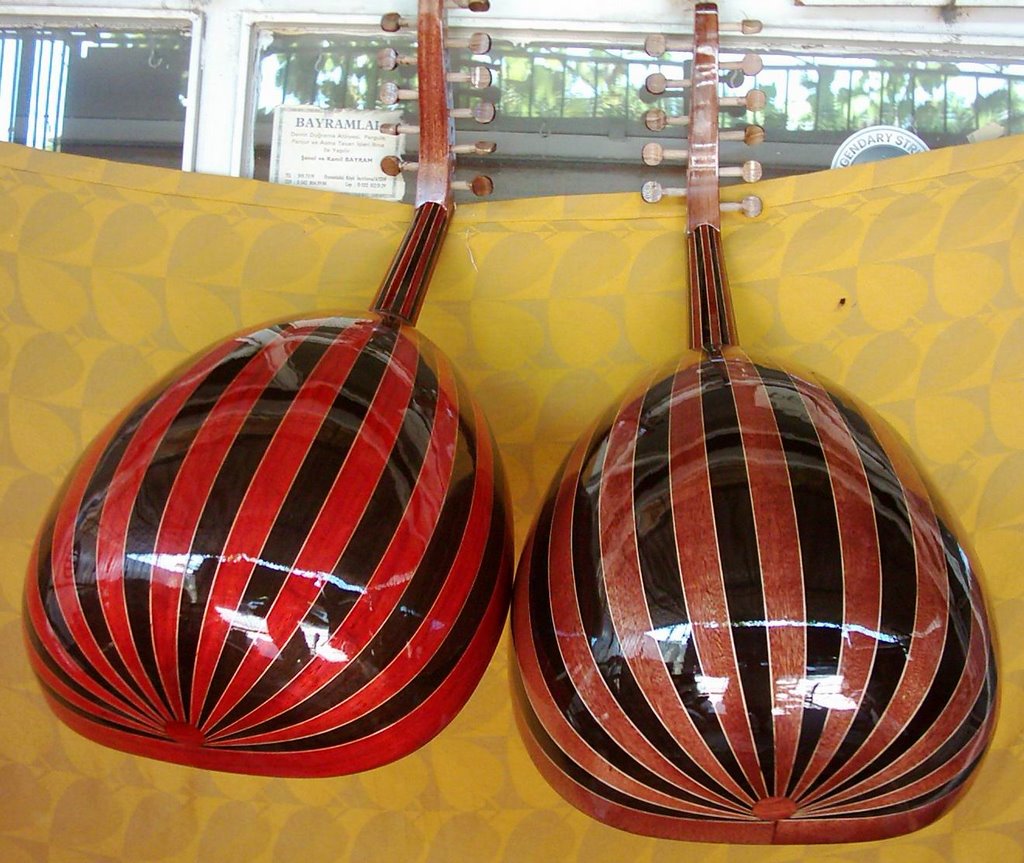
As one or two of you may remember, I ordered my oud directly from a Turkish luthier, Haluk Eraydin. Mine is the one on the right, up above. A beautiful instrument, which arrived in perfect condition in its crate last fall, but it had never sounded quite as loud or as compelling as I had imagined. I had heard from other members of Mike's Oud Forum that I should put a new set of strings on the oud, and Aquila strings seemed to be the top recommendation. (Indeed, Haluk's best quality ouds come with these as standard equipment, but not his learner model.) But I hemmed and hawed over the decision, unsure whether I should order strings for Turkish or Arabic tuning, and the months went by.

(You see, I fell in love with the oud in Arabic music, but could afford a better-quality Turkish oud, and had read on a number of websites that learner-model Turkish ouds were generally better made than comparably priced Arabic instruments. The Turkish / Armenian tuning is a full tone higher than the Arabic, however: EABead, as a rule, rather than CGAfgc, although there are other competing tunings out there for both, and Bashir-style ouds that are tuned even higher. But I digress.)

A few months ago, the decision was made for me by a new book: an Oud Method by Armenian
oudist John Bilezikjian, which I picked up on Amazon.com. It gave me the chance to, well, learn to play the instrument, rather than simply noodle around, as I'd been doing since I bought it. And as you might expect, Bilezikjian writes it for an oud tuned to Armenian tuning.

The long and the short of it is this: I ordered some Aquila strings, put them on--a slightly more complicated process than restringing a guitar, but not much more--and have been stunned and delighted. It's like a new instrument: twice as loud, twice as resonant, and a joy to play. My son still laughs at me; he thinks all plucked string instruments are essentially the same. (What do you expect? He plays clarinet and piano.) But I pluck my little scales and exercises nightly after dinner, learning to handle my mizrap, and I'm having a blast. I figure I'll just have to buy a second oud to keep in Arabic tuning, once I've saved up.

Hmmm... Either that or a Celtic harp.

Saturday, June 24, 2006

Versions of Sappho


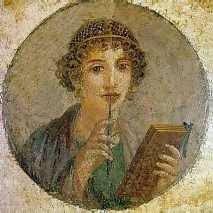
Mark, God bless him, welcomes me back to cyberspace, but mourns Anne Carson's "tin ear." Tin andra, tin earoa, tina turner, say I--but for comparison's sake, here are two other versions of the piece. The first is from Jim Powell's Sappho: a Garland:

Artfully adorned Aphrodite, deathless
child of Zeus and weaver of wiles I beg you
please don’t hurt me, don’t overcome my spirit,
goddess, with longing,

but come here, if ever at other moments
hearing these words from afar you listened
and responded: leaving your father’s house, all
golden, you came then,

hitching up your chariot: lovely sparrows
drew you quickly over the dark earth, whirling
on fine beating wings from the heights of heaven
down through the sky and

instantly arrived—and then O my blessed
goddess with a smile on your deathless face you
asked me what the matter was this time, what I
called you for this time,

what I now most wanted to happen in my
raving heart: “Whom this time should I persuade to
lead you back again to her love? Who now, oh
Sappho, who wrongs you?

If she flees you now, she will soon pursue you;
If she won’t accept what you give, she’ll give it;
If she doesn’t love you, she’ll love you soon now,
Even unwilling.”

Come to me again, and release me from this
want past bearing. All that my heart desires to
happen—make it happen. And stand beside me,
goddess, my ally.

And here's the Guy Davenport,

from Seven Greeks:

Aphrodita dressed in an embroidery of flowers,
Never to die, the daughter of God,
Untangle from longing and perplexities,
O Lady, my heart.

But come down to me, as you came before,
For if ever I cried, and you heard and came,
Come now, of all times, leaving
Your father’s golden house

In that chariot pulled by sparrows reined and bitted,
Swift in their flying, a quick blur aquiver,
Beautiful, high. They drew you across steep air
Down to the black earth;

Fast they came, and you behind them. O
Hilarious heart, your face all laughter,
Asking, What troubles you this time, why again
Do you call me down?

Asking, In your wild heart, who now
Must you have? Who is she that persuasion
Fetch her, enlist her, and put her into bounden love?
Sappho, who does you wrong?

If she balks, I promise, soon she’ll chase,
If she’s turned from gifts, now she’ll give them,
And if she does not love you, she will love,
Helpless, she will love.

Come, then, loose me from cruelties.
Give my tethered heart its full desire.
Fulfill, and come, lock your shield with mine
Throughout the siege.

Each has its felicities, I think, even the Carson--although, to be fair, hers are mostly pedagogical, rather than matters of pleasure.

More on Sappho tomorrow, mebbe. --E

Thursday, June 22, 2006

You know...

...I'm not dead yet. More or less. That grading--whew! Hard to do when you're teaching a new summer class at the same time. To be honest, though, I haven't been blogging because I haven't been reading blogs myself much recently, or even thinking about poetry, poetry teaching, and the other ostensible subjects of this little enterprise. And, of course, the longer you go without blogging, the less you feel like doing it, no? First comes guilt, then resignation: by now, who's going to be reading? Yesterday, though, one of my graduate students told me she'd just discovered the blog, and she was so excited by it. A teacher, she was out looking for lesson plans, etc., and I guess this was just what she needed. So I'm back--and Maria, thanks!

***

Most of my intellectual life these days is focused on romance fiction, my new area of inquiry. I love the books, and I love the happiness with which any new scholar joining that community gets welcomed. I haven't yet found the sort of sniping one sees in poetry criticism, nor the bickering about schools, etc., that bores me to tears in so many poetry venues. Not that I plan to leave poetry criticism for good, but I must say, given the choice between reading a new book on poetry or a new romance novel, I'm going with the little heart sticker more and more. Is it just the novelty? The ease? Or is there some deeper, substantive reason? Hmmm. Something to mull over at the pool, perhaps, this afternoon.

***

Reading Eloisa James's Duchess in Love last week I hit this passage, in which our hero, Cam, a sculptor, considers his next project:
...he spent the morning starting at the marble lump in the corner of his bedroom. Should he sculpt Gina as a pink, naked Aphrodite? A pleasant thought.

Even more pleasant when the duchess herself stood before him. She would make a lovely Aphrodite. Unusual for an Aphrodite, of course. She was slimmer than the normal model, and her face was far more intelligent. The Aphrodites he could bring to mind had sensual, indolent faces, like that of Gina's statue. Whereas her face was thin with a look of curiosity. But why should Aphrodite, as the goddess of eros, of desire, be indolent? Why shouldn't she have precisely that innocent look combined with a gleam of erotic curiosity--the look in his wife's eyes?
One thinks, of course, of Sappho's "Hymn to Aphrodite," whose goddess is anything but indolent and sensual. And where better to find such an echo than in a popular romance novel?

Here's the Sappho, by the way, in Anne Carson's translation. I generally give my Love Poetry students this one, and Guy Davenport's version, and also Jim Powell's, and we work by triangulation. Enjoy.
Deathless Aphrodite of the spangled mind,
child of Zeus,who twists lures, I beg you
do not break with hard pains,
O lady, my heart

but come here if ever before
you caught my voice far off
and listening left your father's
golden house and came,

yoking your car. And fine birds brought you,
quick sparrows over the black earth
whipping their wings down the sky
through midair---

they arrived. But you, O blessed one,
smiled in your deathless face
and asked what (now again) I have suffered and why
(now again) I am calling out

and what I want to happen most of all
in my crazy heart. Whom should I persuade (now again)
to lead you back into her love? Who, O
Sappho, is wronging you?

For if she flees, soon she will pursue.
If she refuses gifts, rather will she give them.
If she does not love, soon she will love
even unwilling.

Come to me now: loose me from hard
care and all my heart longs
to accomplish, accomplish. You
be my ally.

Thursday, May 04, 2006

Back Again!


Hello, everyone. Sorry about the long absence again--I've been busy over at the Big Jewish Blog, as some of you have clicked over and seen, and have been putting most of my off-campus efforts into (drum-roll, please) RomanceScholar, my new listserv for academics interested in popular romance fiction. Unlike my poetry-teacher Yahoo group, which has gone quiet for a while (gee, are school-teachers busy people?), RomanceScholar seems to be a lively bunch. Swing by, if you have an interest; if you don't, and you're a graduate student or college professor, think about joining the Say Something Wonderful Yahoo group and sparking things up a little!

Especially, come to think of it, if you have ANY IDEAS AT ALL about teaching Gertrude Stein. Tried again two nights ago--the bunch of Tender Buttons and the scrap of Lifting Belly in the Rothenberg / Joris Poems for the Millennium anthology, vol. 1. We did well enough, but I'm so out of sympathy with the texts themselves that I begin to wonder whether I should just stop teaching them entirely. If you're out there, and you love to teach Stein, please weigh in and give me some suggestions.

The problems I had teaching Stein put in sharp relief the great pleasure I have had teaching an entirely new poet for me this quarter: the medieval Sufi poet Ibn 'Arabi, in the marvellous translations of Michael Sells. Stations of Desire, the book is called; between its introduction, and a couple of Sells's shorter pieces on apophatic (negative) theology in Sufi thought, I had just enough in my head to go into class and tell the kids we were going to try to figure out a few of these poems, working collectively, and see what we could learn there. My goodness it was fun! The way these poems flicker between human and sacred love--the ways they layer these, compellingly, bringing all of the emotional variety of the former to play in their version of the latter--just a joy. I'm blogging from work, and my copy is at home, but I'll post a sample soon.

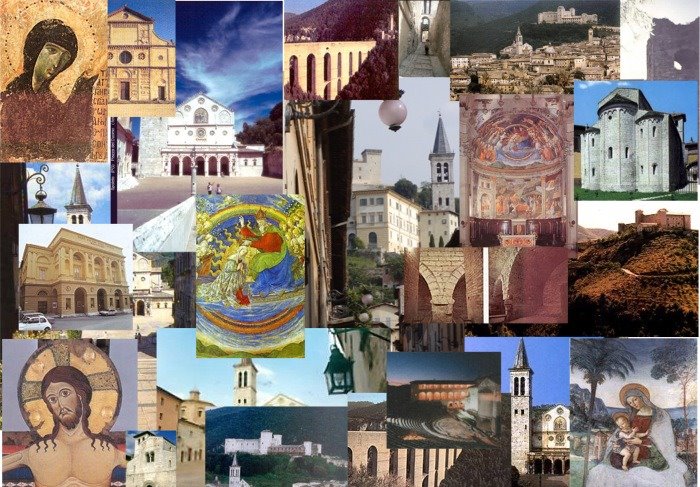
As long as we're ending on a happy note, let me give a quick mention to a writers' workshop that sounds wonderful to me--the kind of thing I don't get to go to myself, but love to spread the word about to others. It's called the "Spoleto Writers' Workshop," and as the name suggests, it's in Spoleto, a hilltown in Umbria, Italy. From the people I know who have gone, it's an intimate sort of workshop: you produce new work every day, experiment with a variety of genres (though the poets work closely on poetry, mostly), and generally have a wonderful experience. It's been going on about a dozen years, so they must be doing something right! Anyway, this summer's faculty are the novelist and poet Rosellen Brown, poet Dorianne Laux (who wrote one of my favorite poems, "The Thief," and novelist and playwright James Magnuson. It runs from July 19-August 2; you can find details here.